How to Choose the Right Glue for Every Repair

Not all glue works the same way.
That might sound obvious, but it is one of the main reasons small repairs fail. A glue that works perfectly on a tiny crack may not be strong enough for a heavier repair. A fast-setting super glue may be great for a clean break, but not ideal if you need time to line up pieces. A thick adhesive may help fill a gap, while a thin one may be better when you need it to flow into a tight crack.
Choosing the right glue comes down to understanding the project in front of you. What material are you fixing? How much strength do you need? Is there a gap to fill? Will the item be used indoors or outdoors? Does the repair need to set fast, or do you need more working time?
Brands like Starbond make this easier because they offer different types of adhesives for different kinds of repairs, including thin, medium, and thick super glues, as well as 5-minute epoxy kits. Instead of trying to use one glue for every job, you can match the adhesive to the repair.
Here is how to choose the right glue for every repair.
Start With the Material

The first thing to consider is what you are actually trying to bond.
Wood, plastic, ceramic, metal, rubber, leather, glass, and stone all behave differently. Some materials are porous and absorb glue easily. Others are smooth, slick, or non-porous, which can make bonding more difficult.
For example, wood often benefits from an adhesive that can soak slightly into the surface. Plastic may need a glue that can grab onto a smooth surface. Metal usually needs a stronger adhesive that can handle stress. Ceramic repairs often require precision because pieces may need to line up cleanly.
Before choosing a glue, look at the material and ask yourself whether the repair is smooth, porous, flexible, rigid, heavy, or delicate. That will help you narrow down the right adhesive.
Use Thin Super Glue for Tight Cracks

Thin super glue is useful when you need adhesive to flow into small spaces.
Because it has a thinner consistency, it can seep into tight cracks, hairline fractures, and small gaps. This can make it helpful for detailed repairs where the pieces already fit closely together and you do not need a thick layer of glue between them.
A thin super glue can be useful for woodworking cracks, small craft repairs, model building, and other detail-focused fixes where control and penetration matter. Instead of sitting on top of the surface, it can wick into the repair area.
Starbond’s thin super glue options are a good example of why having different adhesive thicknesses matters. A thin formula gives you a different kind of control than a thicker glue, especially when the repair needs precision.
Use Medium Super Glue for General Repairs
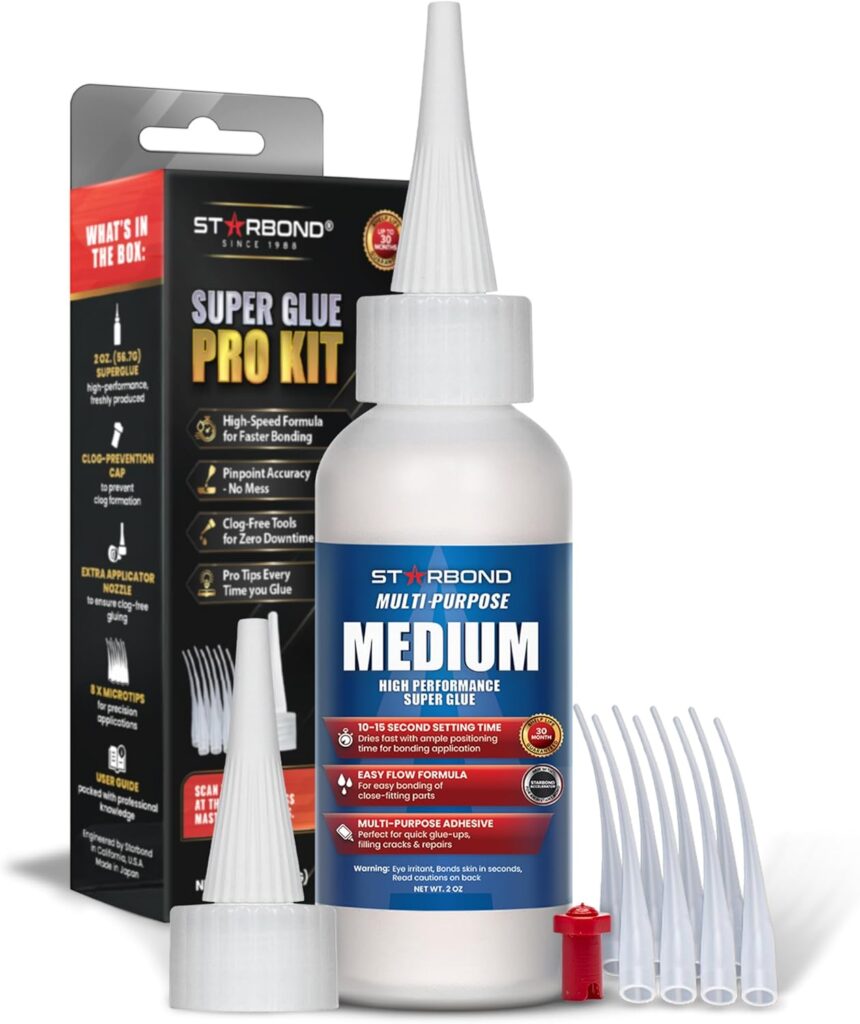
Medium super glue is often the most versatile option.
It is not as watery as thin super glue, but it is not as thick as a gap-filling formula. That makes it useful for many common repairs around the house, garage, workshop, or craft table.
Medium super glue can work well when you need a strong, fast bond on pieces that fit together fairly well. It gives you a little more control during application than very thin glue, but it still sets quickly and works for many small repairs.
This is the kind of adhesive that is helpful to keep in a junk drawer, repair kit, or toolbox because it can handle a wide range of everyday fixes. If you are repairing a small household item, reattaching a piece, fixing a craft project, or handling a clean break, medium super glue is often a good place to start.
Starbond’s medium super glue options are especially useful for people who want one adhesive that can handle many small and moderate repairs without being too thin or too thick.
Use Thick Super Glue for Gaps and Uneven Surfaces
Sometimes the pieces you are fixing do not fit together perfectly.
Maybe there is a missing chip, a slightly uneven break, or a small gap between the surfaces. In those cases, thin glue may run too much, and medium glue may not provide enough body. That is where thick super glue can be helpful.
Thick super glue has more body, so it can stay where you put it. It is useful when you need more control, when the surface is uneven, or when there is a small gap that needs filling.
This can be helpful for certain woodworking projects, crafts, trim repairs, decorative items, and thicker materials where a runny adhesive would be frustrating.
Brands like Starbond offering thin, medium, and thick super glues is helpful because each thickness solves a different problem. Instead of fighting the wrong glue, you can choose the one that behaves the way your repair needs it to.
Use Epoxy for Stronger Repairs
Super glue is great for quick fixes, but epoxy is often the better choice when you need a stronger, more durable bond.
Epoxy usually comes in two parts that are mixed together before use. Once combined, the mixture cures into a tough bond that can be useful for heavier repairs, stronger materials, and projects where you need more durability than a quick dab of super glue can provide.
A 5-minute epoxy kit is especially useful because it gives you working time to position pieces before it starts setting. That can be helpful when you need to line something up carefully, fill a small space, or create a stronger repair.
Starbond’s 5-minute epoxy kits are a smart addition to a home repair setup because they give you another option beyond super glue. For repairs that need more strength, more filling ability, or more time to adjust the pieces, epoxy can be the better choice.
Think About How Fast You Need It to Set
Speed matters when choosing glue.
Sometimes you want a fast repair. A small broken piece, a loose decorative item, or a quick craft fix may only need a fast-setting super glue. In those cases, speed is helpful because you can get the repair done quickly and move on.
Other times, you need more time. If the pieces must be aligned carefully, clamped, adjusted, or positioned at a specific angle, an adhesive that sets too fast can become frustrating. That is where epoxy can be helpful because it gives you more working time before it cures.
The right choice depends on whether the project needs speed or control.
Consider Strength and Stress
Not every repair carries the same amount of stress.
A decorative item that sits on a shelf does not need the same bond strength as something that gets handled, pulled, bumped, or used often. A lightweight craft repair does not need the same adhesive as a heavier household fix.
Before choosing glue, ask yourself how the repaired item will be used.
Will it hold weight? Will it be moved often? Will it be exposed to vibration? Will it be handled daily? Will it be pulled or twisted?
For light, clean repairs, super glue may be enough. For heavier or more demanding repairs, epoxy may be the smarter choice.
Match the Glue to the Gap
The size of the gap matters more than people think.
If two pieces fit tightly together, thin or medium super glue may work well. If there is a small space between them, a thicker glue or epoxy may be more useful.
Thin glue can run out of gaps. Thick glue can bridge small spaces better. Epoxy can fill and bond at the same time, which makes it helpful for certain uneven repairs.
This is one of the biggest reasons it helps to keep more than one adhesive on hand. One bottle of glue cannot behave perfectly in every situation.
Keep a Small Adhesive Kit at Home
A good repair kit does not need to be complicated.
For most homes, it helps to keep a few adhesive types available: a thin super glue for tight cracks, a medium super glue for general repairs, a thick super glue for small gaps or uneven surfaces, and a 5-minute epoxy kit for stronger repairs.
That kind of setup covers a lot of common situations. You can fix small cracks, reattach broken pieces, handle craft projects, repair household items, and tackle stronger bonds without running to the store every time something breaks.
This is where Starbond is a useful brand to consider. Because they offer multiple thicknesses of super glue along with epoxy kits, it is easier to build a small adhesive kit that actually works for different kinds of repairs.
Use Glue Safely and Carefully
No matter which adhesive you choose, always read the instructions before using it.
Work in a well-ventilated area, protect your hands and surfaces, and avoid using too much glue. More adhesive does not always mean a stronger repair. In many cases, a small, controlled amount works better than overloading the surface.
Make sure the area is clean, dry, and free of dust or oil before applying glue. Hold or clamp the pieces in place as needed, and give the repair enough time to cure before using the item again.
A little patience can make the difference between a repair that holds and one that fails.
Final Thoughts
Choosing the right glue is about matching the adhesive to the repair.
Thin super glue works well for tight cracks and precise fixes. Medium super glue is a strong everyday option for general repairs. Thick super glue helps with gaps, uneven surfaces, and projects that need more control. Epoxy is better when you need a stronger bond, more working time, or a repair that can handle more stress.
Brands like Starbond make this easier by offering different thicknesses of super glue, including thin, medium, and thick formulas, along with 5-minute epoxy kits for stronger repairs.
Instead of guessing, choose the adhesive based on the material, gap size, strength needed, and how much time you need to work. With the right glue on hand, small repairs become much easier to handle, and broken items do not always have to be replaced.